fbpx

September 2025 Monthly Market Update

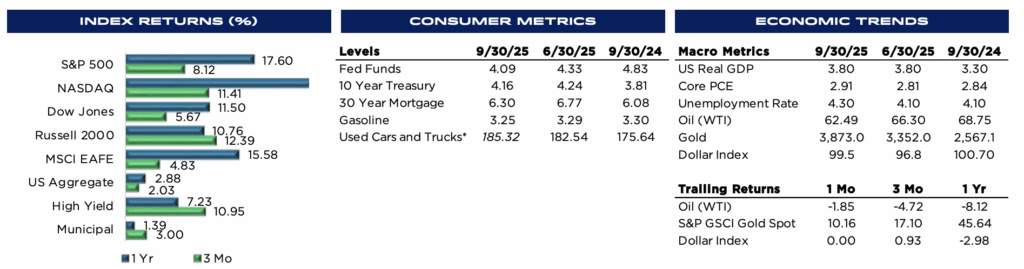
Equities extended their gains through the end of September, with the S&P 500 rising 3.7 percent in the month bringing it to 14.8 percent on the year. Leadership continued to come from large-cap technology and AI-oriented stocks with investor sentiment improving alongside declining bond yields, persistent economic growth, and solid corporate earnings. U.S. equity markets showed modest improvement in breadth with small caps (Russell 2000, +3.1%) participating but the U.S. equity market overall continued on its top-heavy, full valuation, AI centric trajectory. International equity markets posted a solid 3.6% gain in September with developed markets returning 1.9% and a broad-based rally across emerging markets of 7.2%. Currency movements weren’t really a factor in September or the third quarter with the USD trading relatively flat though the year-to-date USD decline of approximately 10% factors largely into international asset out performance over USD denominated assets. Falling interest rates and tighter credit spreads in September helped bonds post solid returns on the month where the Bloomberg Barclays Aggregate and Government/Credit indices each returned 1.1%. The municipal bond market jumped 2.3% thanks to a notable decline in new issues. In terms of commodity markets, oil prices softened toward the low $60s, gold held near record levels, and silver extended strong year-to-date gains of more than 30 percent.

Economic data in September depicted a slowing but still-resilient backdrop. The government shutdown delayed the official September labor market report but alternative data sources and downward revisions to prior months show a sluggish labor market with the unemployment rate likely holding near 4.3% and wage gains continuing to moderate given the softening backdrop. Inflation readings remain elevated but contained with core PCE at 2.9% and headline PCE at 2.6% year over year— largely matching expectations. Manufacturing and services surveys remained in expansionary territory, while retail sales and durable-goods orders reinforced healthy consumption dynamics. The housing market remained constrained by affordability and limited supply, but overall demand across goods and services stayed firm. Corporate earnings results for the third quarter reflected solid profit margins and disciplined cost management in the face of rising tariff levies. Key policy developments in September included the Federal Reserve resuming its rate-cutting campaign, reducing the Fed Funds rate by 25 basis points to a range of 4%-4.25%. The FOMC signaled continued data dependence while acknowledging the need to balance softness in the labor market with progress toward its inflation goal of 2%. Trade headlines remained prominent as the administration announced new tariff levies amidst court challenges on the constitutional legality of executive branch power to levy tariff taxes. 

Fiscal policy was relatively quiet following passage of the July budget bill, but government funding disputes, as expected, resulted in a shutdown at month end. Taken together, September marked another month of broad gains for global financial markets, supported by resilient U.S. economic data, accommodative policy, and strong corporate earnings. Despite signs of moderation in growth and above target inflation dynamics, the prevailing tone remained constructive as investors balanced a slower but stable expansion against a more constructive policy backdrop.

Be a Smart Investor

Stay up-to-date with industry-leading information and news delivered straight to your inbox.

Get our timely insights delivered to your inbox (Blog)

  • This field is for validation purposes and should be left unchanged.

Please remember that past performance may not be indicative of future results. Different types of investments involve varying degrees of risk, and there can be no assurance that the future performance of any specific investment, investment strategy, or product (including the investments and/or investment strategies recommended or undertaken by Opal Wealth Advisors, LLC [“OWA]), or any non-investment related content, made reference to directly or indirectly in this commentary will be profitable, equal any corresponding indicated historical performance level(s), be suitable for your portfolio or individual situation, or prove successful. Due to various factors, including changing market conditions and/or applicable laws, the content may no longer be reflective of current opinions or positions. Moreover, you should not assume that any discussion or information contained in this commentary serves as the receipt of, or as a substitute for, personalized investment advice from OWA. OWA is neither a law firm, nor a certified public accounting firm, and no portion of the commentary content should be construed as legal or accounting advice. A copy of the OWA’s current written disclosure Brochure discussing our advisory services and fees continues to remain available upon request or at www.opalwealthadvisors.com. Please Remember: If you are a OWA client, please contact OWA, in writing, if there are any changes in your personal/financial situation or investment objectives for the purpose of reviewing/evaluating/revising our previous recommendations and/or services, or if you would like to impose, add, or to modify any reasonable restrictions to our investment advisory services. Unless, and until, you notify us, in writing, to the contrary, we shall continue to provide services as we do currently. Please Also Remember to advise us if you have not been receiving account statements (at least quarterly) from the account custodian.